 Hardanger Shop
Winter
Hardanger in winter: which side you come from
You cannot choose the snow. You can choose the road and the day: from the east the crossings shut 2 to 44 days a year, and four museums share only Thursday and Friday.
Send it on hardanger.shop/guide/en/hardanger-in-winter
The shortest day in Odda has 5 hours and 51 minutes of sun, and the walk to Trolltunga takes 8–12 hours.
- Closed days a year, the crossings from the east2 to 44Statens vegvesen, read 5 November 2026
- The shortest day, clear horizon5 h 51 minMET Norway, Odda, 21 December 2026
- Lærdal tunnel, shut for 12 hoursFrom 16 NovemberStatens vegvesen, for two years
Which side you come from
Come from Bergen and you have the easiest road. Bus 930 runs by way of Norheimsund to Tørvikbygd, over the fjord on the ferry to Jondal, and on to Odda. The ferry takes about 20 minutes. No place on that route appears on the list of mountain crossings kept by Statens vegvesen, the road authority, 108 rows long. That does not make the road safe every day, and we will come back to that. But there is no high mountain with a barrier in between.
Come from the east and you have to go over. These are the road authority's own averages for closed days a year, best to worst:
| Crossing | Highest point | Closed days a year |
|---|---|---|
| E16 Filefjell | 992 m | 2 |
| E134 Seljestad–Håra | 877 m | 2 |
| Rv 52 Hemsedalsfjellet | 1134 m | 7 |
| E134 Haukelifjell | 1111 m | 16 |
| Rv 7 Hardangervidda | 1251 m | 35 |
| Rv 13 Vikafjellet | 988 m | 44 |
One road is left out of the table on purpose. Fv 520 Breiborg–Røldal has 165 days and is "vanligvis vinterstengt", usually closed for winter, from 10 December to 15 May. It is not a choice you have.
With a car and a choice, take Haukeli over the plateau. The numbers are one reason. A road authority memo gives another: on Haukeli a convoy can stop in the tunnel, but "På Hardangervidda er det ikke en tilsvarende tunell", the plateau has no such tunnel. Start a convoy there and it has to go all the way over. And on the plateau private cars are stopped much earlier than on Haukeli, the memo says. The same memo counts closed hours for five winters, 2019/20 to 2023/24: Haukeli 36 to 262 hours each winter, Hardangervidda 180 to 737. NRK writes "i snitt stengt 1000 timer i året", 1,000 hours a year on average, of the plateau. These figures probably do not count the same thing, so we do not convert one into another.
Vikafjellet is no shortcut, whatever the map suggests. The road authority calls it "den fjellovergangen i Sør-Norge som er oftest stengt", the crossing in southern Norway most often closed.
Each crossing on the list has its own page with the risk of closure and convoy for the next few hours. Read it on the morning you drive, not the night before. And never put a booked guide or an early ferry on the day after a crossing. Keep a night in hand.
Behind the plough
A convoy is the mountain open, but not to you alone. A snow plough or lead vehicle goes first, another goes last, and you keep the car ahead in sight with your hazards on. The road authority puts it this way: "Use your hazard warning lights, keep the vehicle in front in sight, and drive at an even speed." You cannot change your mind on the way: "Do not exit the convoy or try to turn around."
Full tank or full battery before you climb. "There are no petrol or charging stations on the convoy routes." The list is short and it is good: torch, tow rope and spade, food and something hot to drink, warm clothes and winter shoes. The crew may turn you away if your clothes or tyres will not do. The queue to join can be long. And you cannot look up the time in advance, because fixed convoy times exist only "på enkelte strekninger i Finnmark", on some stretches in Finnmark, far to the north.
If the barrier is down you do not drive round it, even under a blue sky where you stand. "Oppe på fjellet kan det være verre enn ved bommen": up on the mountain it can be worse than at the barrier. We have not driven in a convoy ourselves. These are the road authority's words.
What is new this winter
Filefjell and Hemsedal have few closed days in the table. This winter that helps less.
Both lead to Lærdal, and the road on from there runs through the Lærdal tunnel. "Måndag den 16. november kl. 18.00 startar den første 12-timars stenginga, og slik vil det halde fram dei neste to åra." The first 12-hour closure starts at 18:00 on Monday 16 November, and it goes on like that for two years. The tunnel is open on the night to Sunday. The times will be strictly enforced, and it is "nyttelaust å kome for seint", useless to arrive late. The advice is "å reise på dagtid", to travel by day. When the plateau is shut by a storm, the tunnel is to stay open, and that is written into the contractor's contract.
Hemsedalsfjellet is "delvis stengt seks dager i uken", part-closed six days a week, until 17 December, for up to 13.5 hours a day, while they blast rock at Storeskar. There is no local detour. From Saturday afternoon to Monday morning the road is open.
At the same time the road authority names Hardangervidda as "ein viktig alternativ rute", an important alternative. So expect more traffic on the crossing that already shuts more often.
You may also read that Rv 7 is to be closed for winter for the wild reindeer. That is a plan with a condition. "Regjeringa vil ta opp att prosjektet med mellombels vinterstengd rv. 7 over Hardangervidda", the government will take the project up again, once chronic wasting disease is under control. We found no decision, no date, and nothing to suggest it applies this winter.
The day the low road shut
The Bergen side is no guarantee. On 22 January 2024 there was a red avalanche warning across much of western Norway. The E16 between Trengereid and Voss was closed for much of the day, and the traffic operator told NRK: "Alle alternativ er stengt grunna ras eller flaum", every alternative is closed by slides or flood. At 15:30 the Rv 13 shut, "den siste opne vegen ut av kommunesenteret Odda", the last open road out of Odda. "Dermed blir kommunen isolert": the municipality was cut off. The mayor worked on getting boats. The coast guard ship KV Tor lay at the quay in Odda.
That same morning Vikafjellet was closed and the E16 over Filefjell was open. So the high road can be open on the day the low one is shut.
We have no count of how often this happens. On 27 February 2026 NRK counted nearly 15 closed roads in Vestland, with the E16 and the Rv 13 near Voss among them. Come over the plateau heading on towards Voss, Ulvik or Kvam and you also have Hardangerbrua to cross, which has alerts of its own. Bound for Odda, Kinsarvik or Tyssedal, you turn south on the Rv 13 at Bu and never cross the bridge. Today's answer is on vegvesen.no/trafikk, not here.
The light
Around 21 December the sun reaches Odda after half past nine and sets before half past three. These figures are from MET Norway, worked out for Odda:
| Date | Sunrise | Sunset | Length |
|---|---|---|---|
| 15 November 2026 | 08:32 | 16:04 | 7 h 32 min |
| 21 December 2026 | 09:36 | 15:27 | 5 h 51 min |
| 15 January 2027 | 09:22 | 16:04 | 6 h 42 min |
| 15 February 2027 | 08:12 | 17:23 | 9 h 11 min |
| 15 March 2027 | 06:51 | 18:35 | 11 h 44 min |
The figures are for a clear horizon, and Odda sits among mountains. On 21 December the noon sun stands 6.5 degrees above the horizon, so the day you see is shorter than the table. We found no source for when it clears the ridge, so we print no date for that.
The shortest day in Odda has 5 hours and 51 minutes of sun, and the walk to Trolltunga takes 8–12 hours. That says most of what a winter trip there is, compared with a summer one.
What is shut
The counter first. Since 1 November 2026 it is "No in-person service available" at the tourist information in Odda. You get answers on +47 48 07 07 77 and at turist@ullensvang.kommune.no, and the brochures lie in the terminal while it is open, 05:00 to 20:30. That is the same terminal inside the furnace house. Kinsarvik, Jondal and Røldal are "Closed for the season".
Trolltunga. "In winter, you should hike only with a guide!" writes Trolltunga AS. That is advice, not a ban, and we found no ban. But take the advice. The walk is 27 km from P2 and 20 km from P3, and "Never hike to Trolltunga if there is a strong wind, heavy rain or fog". Our own photograph from there is from 15 May 2017, with snow still lying. Ask the guides which days they go. The seasons printed on the pages that list them do not agree.
The falls on the scenic routes. "Parts of road 13 (Skjervsvegen) are closed in winter", and then you cannot reach Skjervsfossen. At Vøringsfossen and Steinsdalsfossen it says "Parts of the attraction are closed in winter", and the page does not say which parts. The toilets at Vøringsfossen are normally open from the beginning of April to November, and at Steinsdalsfossen from early May to late October. So do not count on them.
And much of the lodging: "Mange overnattingsstader i Hardanger har vinterpause", many places to stay take a winter break, writes Visit Hardangerfjord. Book the room before you book the rest.
What is open, and on which days
If you want museums, come on a Thursday or a Friday. Those are the days these four are all open, and between 11 and 15 the hours overlap too: Kraftmuseet in Tyssedal (Tuesday to Friday), Kabuso in Øystese (Thursday to Sunday), the Hardanger maritime centre in Norheimsund (Thursday to Sunday) and the Hardanger folk museum at Utne (Monday to Friday). None of the pages sets them side by side, so that is our own working.
Two limits. The hours of the museums under Hardanger og Voss museum are headed "fall and spring", and none says outright what applies in January, so phone before you drive in midwinter. And Kabuso is closed on Thursday 19 November. The path to Lilletopp in Tyssedal, though, is "open heile året", open all year.
Food: Visit Hardangerfjord names Buer Restaurant, Sjøhuset Restaurant & Pub and Restaurant Glime at Hardangerfjord Hotel on its winter page, with the note "Hugs å sjekka opningstider", remember to check opening hours. Cider: treat a farm shop as closed until someone answers the phone. Taste Hardanger prints different things for different farms, and many say "on request". Who makes the cider is in the cideries piece.
Skiing: Røldal Skisenter plans to open on 26 December 2026, "snøforbehold", snow permitting, and to run until about 2 May 2027. On the fjord: Fjord Floating from Norheimsund has a season from October to April. You float on the fjord for 30–45 minutes in a warm, insulated survival suit, with a guide close by, and you do not need to swim.
What not to come for
The northern lights. The aurora zone lies over the coast of Troms and Finnmark. Visit Norway says you can "sometimes" see them in western Norway, particularly during increased solar activity. The regional winter page does not mention them at all. It offers stars and little light pollution: "on clear winter nights you’ll often experience an incredible star-filled sky". We found no source for how often the lights show at Odda. If they come, they are a gift. Do not book a trip on them.
A Christmas market with a date. Last year Hardanger Folkeblad reported plans for a market at Camp Lothepus in Odda, 10–14 December 2025. We found no date for 2026, so we print none.
When the trip is worth it
Go if you want the fjord with fewer tourists around you, if you have booked a guide or a week in Røldal, and if you can move a day. Do not go to tick off a list of waterfalls, and do not go to walk Trolltunga alone. From Bergen we would take the bus and the ferry. From Oslo we would drive Haukeli, by day, with a spare night in hand.
We have not been in Odda in winter for this piece, and we have not stood at a closed barrier. What we have done is read the pages of the people who run the roads, and set them side by side. None of the pages we read had done that.
From the shop
If you want the snow without the convoy, the quay, the fjord and the rock can come by post: two drawings and one photograph of ours, on the mug.


We have no physical shop in Odda. What you order is printed to order and sent by post.
Sources
Checked 5 November 2026:
- Statens vegvesen, the pages for Filefjell, Seljestad–Håra, Hemsedalsfjellet, Haukelifjell, Hardangervidda, Vikafjellet and Breiborg–Røldal: "Gjennomsnittlig antall døgn med stengt vei per år". The pages do not say for every figure how many years it rests on.
- Fjelloverganger, Statens vegvesen, 108 rows. We searched the list for the places on the route of bus 930 as far as Odda. After Odda the bus goes on to Seljestad, and Seljestad–Håra is on the list. Our sentence stops at Odda.
- Konklusjon etter vurdering av egen tungbilkolonne på E-134 Haukeli, Statens vegvesen, posted on at.no in February 2025, with no date in the text. The memo says "1/5" of Haukeli against the plateau. Its own table gives about a quarter, so we print the numbers and not the fraction.
- How to drive in a convoy, Kolonnekjøring (updated 31 August 2021), Generell informasjon om fjelloverganger and alerts for tunnels and bridges, Statens vegvesen.
- Lærdal tunnel, 23 September 2026, Hemsedalsfjellet, 16 October 2026, and Skredsatsing, 25 February 2025, Statens vegvesen.
- Tiltaksplan for Hardangervidda villreinområde, Klima- og miljødepartementet, 2026, and NRK Buskerud, 14 July 2026.
- NRK Vestland, 22 January 2024 and 27 February 2026.
- Timetables, Skyss, and Jondal–Tørvikbygd, Fjord1. We print no departure times.
- MET Norway, Sunrise API 3.0, 60.067 N, 6.546 E. The length is our own subtraction.
- Guided hikes and Trolltunga in winter, Trolltunga AS.
- Nasjonale turistveger: Hardanger, Hardangervidda, Vøringsfossen and Steinsdalsfossen.
- Visit Hardangerfjord: tourist information in Ullensvang, Vinter i Hardanger, Winter in Hardanger, 6 reasons and Fjord Floating.
- Opening hours, Hardanger og Voss museum, Kabuso, Kraftmuseet, Røldal Skisenter and Taste Hardanger.
- Nordlys, Store norske leksikon, updated 25 March 2026, and Northern lights, Visit Norway.
- Hardanger Folkeblad, 24 September 2025.
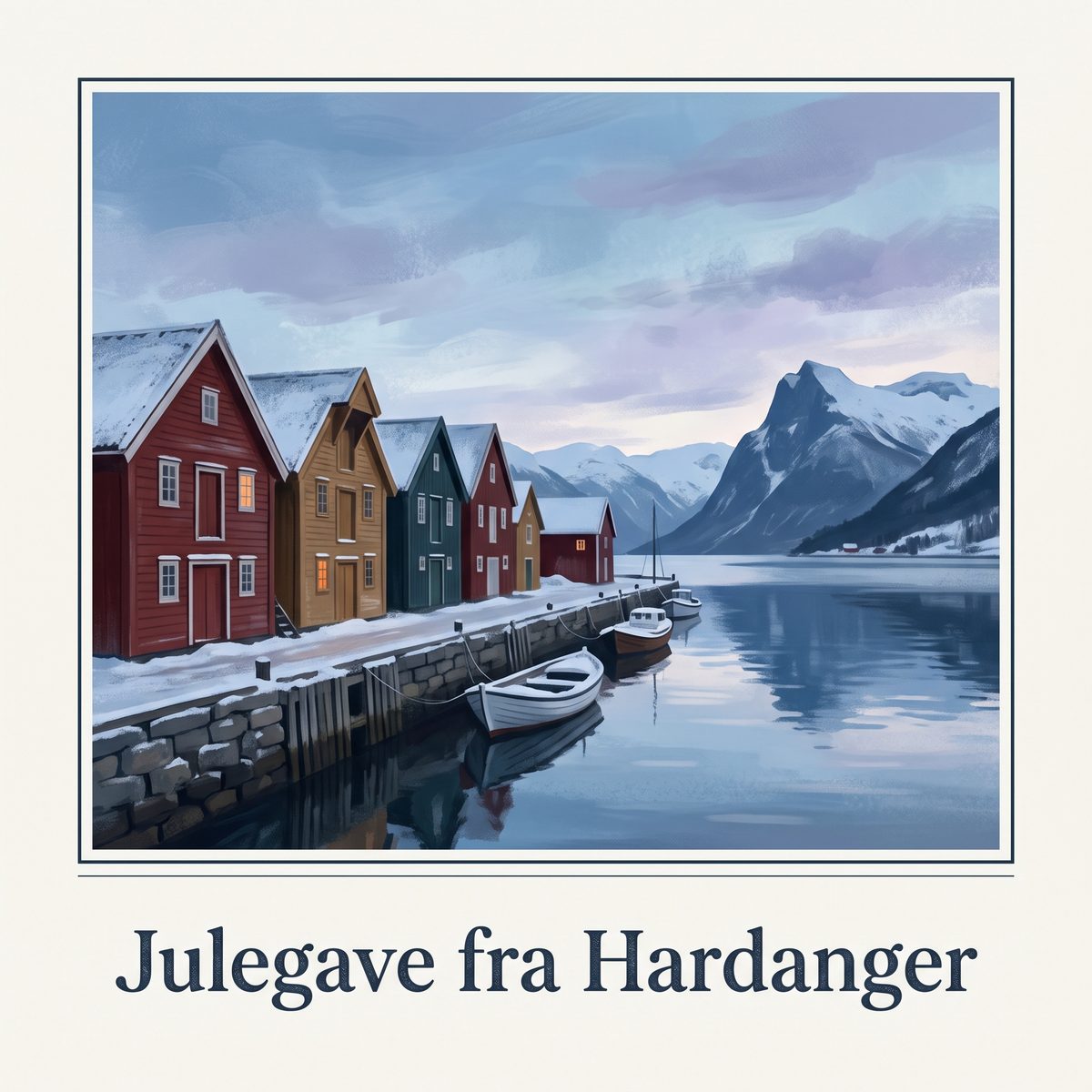
- The Trolltunga photograph is ours, 15 May 2017. The drawing at the top is the Julegåve winter quay design, approved 15 September 2026.