 Hardanger Shop
Industry
Odda is a smelter town
In Odda you wait for the bus inside a protected furnace house. The power station that ran the smelter stands 6 kilometres away, and the World Heritage bid Odda shared with Rjukan–Notodden went to Rjukan–Notodden alone.
Send this on hardanger.shop/guide/en/odda-smelter-town
In Odda you wait for the bus inside a protected furnace house.
- The smelter1908–2002
- Tysso I, Tyssedal6 km north
- Terminal in Furnace 34 May 2026
The terminal
In Odda you wait for the bus inside a protected furnace house. Odda Terminal opened on Monday 4 May 2026 in Ovn 3, Furnace 3, which is protected as a national cultural monument. That is from the press release of Novaform, who managed the project. Inside are the waiting room, with a view of the old furnace, brochures and digital tourist information from Ullensvang municipality, and a rest room for the Skyss and Tide drivers.
The address is Smelteverket 33. Since 1 November 2026 nobody staffs it. You will find brochures and digital information in the terminal, and otherwise it is phone +47 48 07 07 77 or turist@ullensvang.kommune.no. That is what Visit Hardangerfjord said when we read it on 3 November 2026.
The furnace started in 1982. Riksantikvaren, the Directorate for Cultural Heritage, calls it the world's largest of its kind. Twenty years later the whole works stood still.
What still stands
Work began in 1906. From 1908 the plant made calcium carbide and calcium cyanamide, a fertiliser. Riksantikvaren again: when it opened, Odda was the world's largest cyanamide factory, and in 1912 it had the largest output in the world.
Largest at what is where the pages part ways. Store norske leksikon says the world's largest carbide factory at the start. Lokalhistoriewiki says Europe's largest. We print what Riksantikvaren prints, and say that it is Riksantikvaren.
Production stopped in 2002 because it no longer paid. The company went bankrupt the year after.
Protection came on 31 March 2011. Of the cyanamide furnaces, the Director General of Cultural Heritage, Jørn Holme, told NRK that these unique furnaces are found nowhere else in the world. The protection was appealed, and the Ministry of the Environment, today the Ministry of Climate and Environment, upheld it on 2 October 2012. The decision covers, among others, the cyanamide factory, Lindehuset, Furnace 3 and its furnace house, the limestone silo on the import quay, the cable-car pylons and the raw-material store. Furnaces 1 and 2 are not protected.
The workers' houses in Folgefonngata belong to the power museum, together with buildings on the smelter site. The museum says so itself, in a letter to Riksantikvaren in May 2025. We have not been inside them.
Search for "Odda smelter" in English and you reach Boliden's zinc works. That is a different plant, and it still runs.
Tyssedal
Power is why the smelter was here. Tysso I in Tyssedal, 6 kilometres north of Odda, began delivering to the smelters in May 1908. Store norske leksikon calls it the first high-pressure plant in northern Europe, with a head of 400 metres. Riksantikvaren says Norway's first. The building is 175 metres long, and Thorvald Astrup drew the first stage. It ran until 1989 and was protected in May 2000.
Today it is Kraftmuseet, Naustbakken 7. Take bus 990 or 995 from Odda and walk five minutes. When we read the page on 7 October 2026 it was open Tuesday to Friday, 10:00 to 15:00, at 125 kroner for adults, 70 for students and free under 16. Visit Hardangerfjord prints a summer season the museum's own page does not show. Check the museum.
The guided tour is booked ahead. "Without a tour it is just a 30-min film," one visitor wrote on Tripadvisor in 2016. We have not taken the tour.
P1 for Trolltunga is in Tyssedal too. If it rains on the day you meant to hike, this is the day.
World Heritage
The industrial heritage of Odda and Tyssedal went on Norway's tentative list in 2009, together with Rjukan–Notodden. That is in Store norske leksikon.
In December 2010 Riksantikvaren took Odda out of the bid, because the municipality was not united behind it, NRK reported. In March 2011 Odda was written back in, on the same day as the protection.
On 18 December 2013 the government sent Rjukan–Notodden industrial heritage to UNESCO. Odda and Tyssedal were not in it. Rjukan–Notodden was inscribed in 2015.
Why Odda dropped out, we have not found in any primary source. A Tripadvisor thread from 2020 still promises that Odda may make the list.
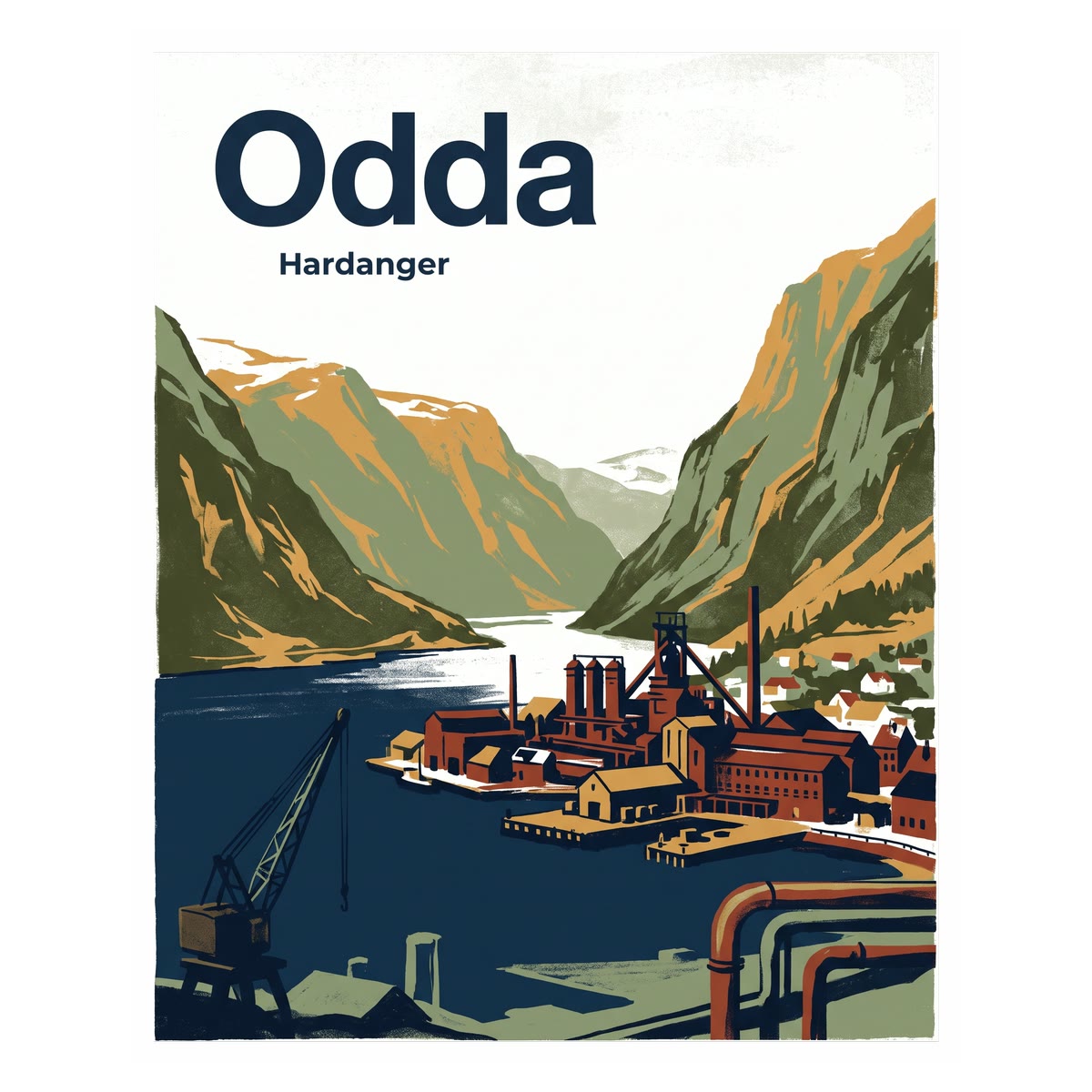
I Love Odda is in about half of the orders the shop has had since 2021, by our own sales figures. People are buying the name of an industrial town. The poster draws it that way.
We have no physical shop in Odda. What we make is printed to order and sent by post.


Sources
Checked 7 October 2026:
- Odda smelteverk, Riksantikvaren, updated 8 May 2025. Begun 1906, in operation from 1908. The world's largest cyanamide factory when it opened, and the largest output in 1912. Furnace 3 from 1982, the largest of its kind. Bankrupt 2003.
- Odda Smelteverk in Store norske leksikon, updated 26 November 2024. Carbide from 1908, cyanamide the year after. The world's largest carbide factory at the start. Production stopped in 2002, bankrupt the year after.
- Odda Smelteverk, lokalhistoriewiki, edited 1 June 2023. Europe's largest carbide factory. Bankrupt 27 February 2003, protected 31 March 2011.
- Smelteverket i Odda fredet igjen, NRK, 31 March 2011. Jørn Holme on the cyanamide furnaces. Odda written back into the World Heritage bid.
- Sier nei til smelteverket, NRK, 21 December 2010. Odda taken out of the bid.
- Appeal decision on the protection of Odda smelteverk, Ministry of the Environment, 2 October 2012.
- Written answer from Erik Solheim, Storting, 4 September 2009. Furnaces 1 and 2 are not protected.
- Odda Terminal offisielt åpnet i fredet ovnsbygg, Novaform press release, 12 May 2026. Opened 4 May 2026 in Furnace 3.
- Tourist information offices in Ullensvang, Visit Hardangerfjord, read 3 November 2026. Smelteverket 33, 5750 Odda, no in-person service from 1 November 2026.
- Tysso I kraftverk in Store norske leksikon, Knut A. Rosvold, updated 8 July 2026. Power from May 1908, a 400-metre head, a 175-metre building, in operation until 1989, protected May 2000.
- Tyssedal kraftverk, Riksantikvaren, updated 20 June 2024. Norway's first high-pressure hydropower plant.
- Visit, Kraftmuseet. Naustbakken 7, bus 990 or 995, hours and prices as they stood on 7 October 2026.
- Letter from Kraftmuseet to Riksantikvaren, 12 May 2025. The power station, the workers' houses in Folgefonngata and buildings on the smelter site.
- Kraftmuseet on Tripadvisor. The review about the film is from 2016.
- Odda in Store norske leksikon, updated 2 March 2026. Tentative list 2009 with Rjukan–Notodden, inscribed in 2015.
- Norge nominerer to nye steder til UNESCO, regjeringen.no, 18 December 2013.
- Parking, trolltunga.com. P1 in Tyssedal.
- NIB lends to Boliden Odda smelter expansion, Nordic Investment Bank. The zinc works that runs today.
- Hardanger Shop, own sales figures, export read 3 November 2026: I Love Odda is in about half of the orders since 2021.